
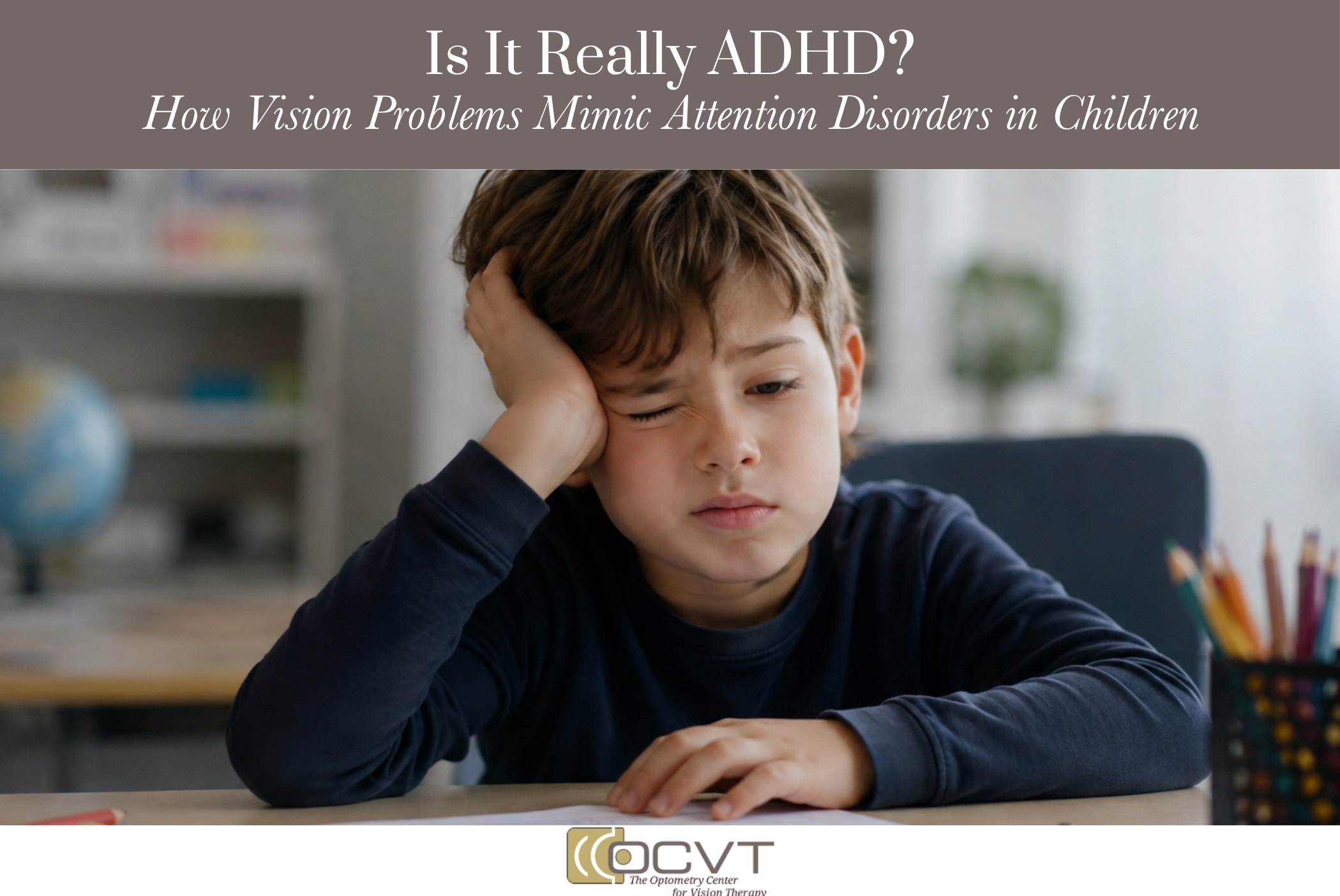
 Every year, thousands of children are diagnosed with ADHD — and many of those diagnoses are accurate. But for a significant number of kids, the restlessness, difficulty focusing, and poor academic performance that looks like attention deficit disorder may actually stem from an undetected vision problem. At The Optometry Center for Vision Therapy (OCVT), we see this pattern regularly: a child has been struggling in school for years, often on medication, and a comprehensive vision evaluation reveals a treatable visual dysfunction that was driving the behavior all along.
The Link Between Vision and Attention
When most people think about vision problems, they think about blurry eyesight — something a pair of glasses can fix. But there’s a whole category of visual dysfunction that has nothing to do with how clearly you see and everything to do with how your visual system processes and interprets information.
Conditions like convergence insufficiency, accommodative dysfunction, and binocular vision disorders affect how the two eyes work together, how well they can sustain focus, and how the brain interprets what the eyes send. When these systems are struggling, reading becomes exhausting. Holding attention on a page feels impossible. The child may squirm, avoid tasks, or act out — not because they can’t focus, but because their visual system is working overtime just to keep the words from doubling or moving on the page.
Research published in journals of optometry and pediatrics has established a clear connection between convergence insufficiency — a condition where the eyes struggle to work as a team for near tasks — and symptoms that mirror ADHD. In fact, a landmark study found that children with convergence insufficiency were three times more likely to be diagnosed with ADHD-like symptoms.
Signs That Vision May Be the Underlying Issue
How do you know if what looks like ADHD might actually be a vision problem? Some of the most common signs include:
- Avoidance of reading or near tasks — the child complains of headaches, eye strain, or “not liking” reading, even if they’re otherwise intelligent and curious
- Losing their place on the page or skipping lines while reading
- Words appearing to move, blur, or double
- Short attention span specifically for near work, but normal attention during hands-on or active tasks
- Tilting the head or covering one eye while reading
- Fatigue after visual tasks that doesn’t show up in other activities
A standard school vision screening — and even a basic eye exam — will not catch these problems. They require a comprehensive developmental vision evaluation performed by a specially trained optometrist.
What OCVT’s Evaluation Looks Like
At OCVT, our board-certified developmental optometrists go far beyond the standard 20/20 chart. A comprehensive evaluation at our Austin or San Antonio offices assesses how well the eyes converge and diverge, how efficiently they track, how quickly and accurately they focus, and how the brain processes the visual input it receives.
For children who have already been assessed for ADHD, this evaluation often provides important missing context. For families who are just beginning to understand why their child is struggling, it can be genuinely life-changing.
Vision Therapy: Treating the Root Cause
If a vision problem is identified, the treatment at OCVT is vision therapy — a structured, individualized program of exercises and activities designed to retrain the visual system. Think of it like physical therapy for the eyes and brain. Over the course of treatment, patients develop the visual skills needed to sustain focus, track accurately, and process information efficiently.
Many families report dramatic changes in their children’s academic performance, behavior, and confidence following vision therapy. In some cases, children who were struggling on medication for ADHD were able to work with their physicians to reduce or discontinue it once the visual root cause was addressed.
This isn’t to say that ADHD isn’t real or that vision therapy is a cure-all. But when a child is struggling, ruling out a treatable vision dysfunction is a critical step — one that’s too often skipped.
If your child has been diagnosed with ADHD or is showing signs of attention and learning difficulties, we invite you to schedule a no-cost consultation at OCVT. It could be the piece of the puzzle you’ve been missing.
